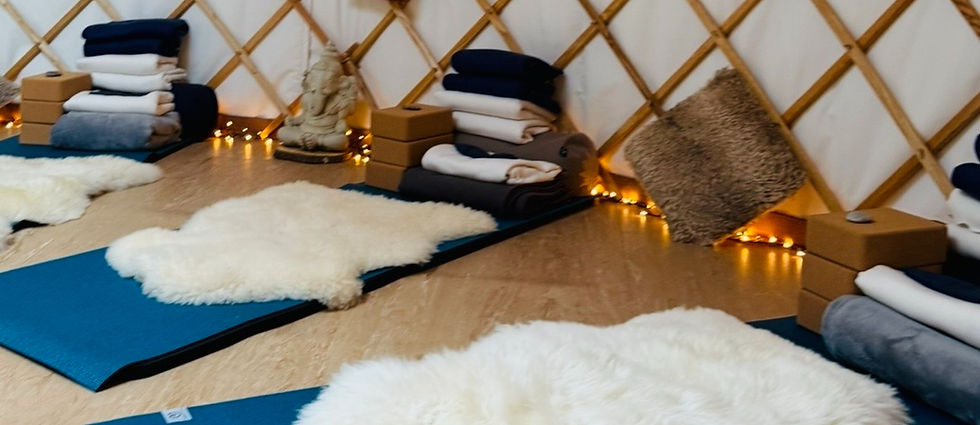
Working in a Yurt, A Life without corners”
- Olivia Carter

- Jan 15
- 7 min read

Life without corners
The circle is the first shape we ever know.
Quite literally, before we are aware of anything, we begin in the soft perimeter of the human womb.
It is the boundary that holds us, round and complete.
In that sense, the circle is our very first home. And even before that, before we begin to develop into the people we are today, we begin as a single cell.
One perfect circle dividing into two, then four, then eight.
The sacred geometry of life.
All of us now living in bodies built upon that primal symmetry, the sacred mathematics of becoming.
Long before we learned to speak and to reason and to question, our existence was already patterned in circles: expansion and return, growth. The shape of all creation lives quietly in our own beginnings.
And yet, somewhere between birth and busyness, we swap curves for corners. We live in rectangles, work in boxes, scroll on squares.
Even our days are divided into neatly stacked blocks of time, thirty minutes here, one hour there, as if the edges of our calendars could somehow contain the dynamic complexities of a life.
My husband however, jokes that circles are expensive.
And he’s right, at least in a practical sense. Try building one, and you’ll quickly find that timber merchants, planners, and budgets are far more comfortable with a straight line.
My husband has previously scoffed at my poetic wonder of the circle.
He says fascination with the magic of circles is an illusion, my mind’s way of making sense of something that has no true beginning or end.
A very male take perhaps on something as sacred and cyclical as the circle itself.
Modern life, after all, has been built in straight lines.
We rise, we strive, we set goals.
It is a system designed for growth, for progress, for forward motion, a distinctly masculine architecture of success.
But women move differently.
We move in cycles. Our energy, our clarity, even our creativity, all ebb and flow. Those who have learned to listen to their own rhythms know that there are times for building and times for retreat, for outward movement and for turning inward.
The circle honours that.
It invites us to remember what the line simply cannot comprehend, that life is not a race to be won, but a constant rhythm to return to.
And then, when I think of our own circle, our beautiful yurt, it’s funny how it came to be.
We had originally planned to put a small garden room on our land.
A rectangle, to be precise. We’d also looked into the idea of a little wooden roundhouse. But the cost was astronomical. My husband, true to form, repeated his favorite line: circles are expensive.
So we settled, quite senibly, on a rectangular building at some point in the future.
A few weeks later, I went to a mediumship evening with a friend. Afterwards, the medium asked if I had a question. “Not really,” I said. “I’m happy for you to see what you pick up.” He thought for a moment and then replied, “They’re showing me a round structure.”
My friend and I laughed, explaining that my husband and I had indeed been thinking about a round structure, but had decided against it because, in inverted commas, curves are expensive.
The medium looked straight back at me, expression unchanged. “No,” he said, “they’re telling me it absolutely must be a circle.” You can imagine the conversation when I got home to tell my somewhat skeptical husband that we had been instructed from ‘beyond’ to return to the idea of a circle.
It’s hard to deny the power of a simple circle.
That being said, from an interior design point of view, they are, to some degree, unashamedly awkward. Not because of how they feel to be in, but because of how we dress them. Let’s be honest, a circle doesn’t make the best use of its square footage. There’s nowhere to compartmentalize our furniture or box in our corners, so we have to be creative. We have to bend to the shape, not the other way around. It demands openness, and most of us find openness uncomfortable.
Being in a circle has no hierarchy, no front row, no corner office. It is far more tribal in that sense. It invites participation instead of observation. In sacred geometry, it represents wholeness and unity, every point equidistant from the centre, everything belonging equally. From a single cell dividing in its perfect roundness, to the orbit of planets or the quiet symmetry of an iris, life seems to prefer curves. There is a kind of intelligence in the round. It contains without confining.
When people step into the yurt, they often pause.
They notice the absence of corners. The eye, instead of landing and stopping, keeps travelling, softening. There’s a reason round spaces feel safe: the nervous system, deprived of hard edges and ambush points, can finally stop scanning. No one sits at the head of a circle.
And of course, the metaphor extends. The breath moves in circles. The seasons turn in circles. Energy flows in circles. Even our relationships, at their best, loop gently between giving and receiving. The linear drive of modern productivity culture tells us to go forward, to climb, to reach the next level. But the circle whispers something quieter: come back. Begin again.
There’s also something quietly universal about our attraction to roundness.
Neuroscientists at the University of Toronto found that people consistently describe curved spaces and objects as more calming and emotionally positive than angular ones. Steve Jobs famously designed Apple’s headquarters as a vast glass circle, “a spaceship of collaboration,” he called it, believing that the shape itself would encourage creativity and flow. From Stonehenge to NASA’s modules, circles have been chosen not just for beauty, but for balance. They distribute sound, energy, and attention more evenly than corners ever could.
Artists have always known this intuitively. Georgia O’Keeffe painted the horizon as a soft loop, calling it her way of “coming back to where everything begins.” The Japanese ensō, a hand-drawn circle painted in a single breath, represents both completion and imperfection, a reminder that wholeness doesn’t require perfection, only presence.
The Enso (Shown above) the single unbroken brushstroke, carries meaning far beyond symbolism.
It reflects a way of understanding flow, balance and spatial intelligence.
In design terms, it represents a closed system: energy contained, redistributed and harmonised.

Architects and engineers have long recognized that what appears poetic on the surface often has deep practical value.
Circular structures, for instance, distribute weight evenly.
A dome or a roundhouse, even the great rotundas and ancient tholos tombs, or any such round structure including a yurt, withstands wind from any direction because no single wall takes the full impact.
The pressure travels around the curve and disperses, creating strength through softness.
It is the same principle that keeps planets in orbit and rivers meandering instead of colliding with their own banks: curves dissipate force rather than resisting it.
Here’s something most of us never stop to question: nature almost never builds in straight lines.
From the spiral of a galaxy to the cross-section of a tree trunk, life favours arcs, circles and curves. The rigid square room we’ve come to think of as ‘normal’ is actually a cultural invention, and when you really stop and think about it, on this planet we call home these squares and lines we have created stick out rather like a sore thumb. They are the product of human intervention, born of industrial-era efficiency and standardized building practices rather than any inherent need in nature itself.
Acoustically, curves change everything.
Sound does not crash into flat walls and bounce back; it rolls, disperses and softens. They reduce corner-based flutter echoes, lengthen useful reverberation for speech and help voices carry more naturally.
Even small changes have measurable effects. One study found that altering a concert hall’s interior curvature by just five percent extended the resonance time of the human voice by nearly a third, enough to change how deeply we process sound. In Malta’s Ħal Saflieni Hypogeum, researchers discovered pronounced resonances in the Oracle Chamber (approximately 70–114 Hz), a frequency range that interacts with the human body itself, proving that geometry can shape sonic experience. In India, measurements at the Kanheri rock-cut chaitya halls showed how apsidal ends and vaulted ceilings diffuse sound so evenly that a whisper carries across the chamber.
The same principles govern light.
In a round space, daylight does not slam into surfaces and stop; it flows, bends and reflects. Corners cast shadows, while circles create continuity. This has psychological consequences too: in studies of classroom and workplace design, people in curved spaces report higher comfort levels, better collaboration and a greater sense of belonging.
Rounded edges literally change how we relate to one another.
Even airflow behaves differently.
In cylindrical or domed structures, convection currents circulate naturally without dead spots, helping to regulate temperature and humidity more evenly. This is one reason why round homes in desert and steppe environments have stood for centuries.
It is tempting to think of these as architectural curiosities, interesting but irrelevant to daily life. But the science points elsewhere. Spaces that echo the geometries of nature affect us in subtle but significant ways: they slow our heart rate, soften our voices, encourage cooperation and even alter the way we move through a room. Straight lines, by contrast, are more likely to trigger alertness and goal-focused thinking, a pattern hardwired into our evolutionary nervous system.
So when we return to the Enso, we are not simply admiring a brushstroke. We are recognising the original architectural sketch for balance and flow. The energy within a circle does not stop or collide; it moves, adapts and returns.
And this point about the energy literally changing interests me.
Of course, the energy I have trained to work with most closely is Reiki: subtle yet powerful, always in motion and always seeking balance. That is why this connection between structure and sensation, between the measurable and the mysterious, fascinates me so deeply.
When people step into a circular space, their bodies often respond before their minds do. Breathing slows. Eyes travel without catching. Conversations soften. And somewhere beneath thought, an ancient part of us remembers: we once gathered in circles not because it was fashionable, but because it was functional and because, on some level, it still feels like home.
As the season begins to turn and the air sharpens, perhaps this is the lesson to take from the circle: to soften the edges of our own lives. To remember that growth doesn’t always mean forward motion, and that sometimes the most radical thing we can do is to pause, to round the corners of our days, and let the line of our attention soften.


Comments